20 January 2022


DR FRANCIS JACKSON


THE CHURCH TIMES, 21 JANUARY 2022

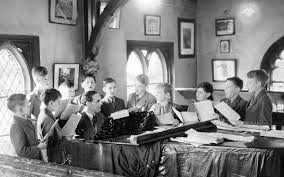
Garry Humphreys writes: DR FRANCIS JACKSON, who has died, aged 104, was for 37 years, from 1946 to 1982, Organist and Master of the Music at York Minster; but he was in fact associated with the Minster for most of his life. In 1929, aged 12, he became a chorister under the legendary Sir Edward Bairstow — “the rudest man in Yorkshire”, according to some — whose biography Jackson was to publish in 1996. He also recorded his complete organ works, despite Bairstow’s aversion to the gramophone.

Jackson was an accomplished writer with a delightful style and dry humour, and a keen observer of those around him, as he revealed in his autobiography, Music for a Long While (adapting the title of Purcell’s famous song), published in 2013, when he was 96. It might be criticised for going into too much detail, but it is this detail that makes it such an illuminating account of a world now largely lost.

He brings a more personal view of Bairstow than in his formal biography, and one of the highlights of the book is his charming description of a visit in August 1951 to the composer Ravel’s house at Montfort l’Amaury, during a holiday in France. Ravel’s housekeeper Madame Reveleau was still in residence. “It was a remarkable thing to meet her who had been in such close touch with him,” he wrote; “as remarkable as seeing the things he had had around him, exactly as he had left them.”

He had admired Ravel and Debussy from a very young age and, as an organist, had promoted in his recitals the music of Franck, Vierne, Widor, and Dupré.

Francis Alan Jackson was born at Malton, 18 miles north-east of York, in 1917. His mother was a Suddaby — he was second cousin to the soprano Elsie Suddaby, one of the original dedicatees of Vaughan Williams’s Serenade to Music — and Francis could not remember being unable to play the piano. The family were also enthusiastic listeners to gramophone records.

“I was born with a natural talent,” Jackson wrote; “and working at it and developing it was pretty well unalloyed pleasure.”

After singing in the choir of Malton Parish Church, he went at 12 to be a chorister at York Minster. Under Bairstow’s guidance, he recalled, “my horizons were widened and I learned that music was not just an exercise merely to be got through but rather a natural expression of one’s very being . . . Bairstow . . . made music alive and, above all, enjoyable and fulfilling . . . And music had to be beautiful.”

Jackson left school at 15, became organist of Malton at 16, and from 1933 was a full-time student with Bairstow; in 1937, he received the degree of Bachelor of Music from Durham University (his doctorate followed in 1957). He succeeded Bairstow at the Minster in 1946.

The transition was a smooth one, but Jackson’s sympathies were much wider than his predecessor’s; for, as a composer, he wrote not only church music, but a symphony, an organ concerto, chamber music, songs, and incidental music for plays. Among his more unusual compositions are two monodramas with narrator, Daniel in Babylon (1962, to celebrate the consecration of Coventry Ca­thedral) and A Time of Fire (1967, for the Norwich and Norfolk Triennial Festival). Both were written in collaboration with the actor-dramatist John Stuart Anderson.

Jackson regarded “Tree at my window” as his best song, setting the poem by Robert Frost. It was written during the Second World War when he was serving with the 9th Lancers in 1942 in the desert campaign near Tobruk. He remembered writing it “in my tent by the light of an oil lamp made from a cigarette tin. There is a bit where the wind blows in the song, and it was actually blowing quite a gale in the desert at the time. I know I kept wondering if the tent was going to fly off.”

Francis Jackson was an outstanding organist — one of the foremost recitalists of his generation — in demand throughout the world; he also acted as adviser to many churches and cathedrals considering organ rebuilds. He was responsible for the rehabilitation of the “Toccata” from Widor’s Fifth Symphony by using it instead of Mendelssohn’s “Wedding March” at the wedding of the Duke and Duchess of Kent in York Minster in 1961, preferring a genuine composition for organ to a hackneyed arrangement of an orchestral piece. He served as President of the Royal College of Organists from 1972 to 1974.

As well as his widely used settings of the Canticles in G (“Me in G”, as he used to call them), he wrote a hymn tune called East Acklam, after the village where he lived, as an alternative to Ar Hyd y Nos for “God that madest earth and heaven” for an Old Choristers’ reunion in 1957. But it was not until the Methodist hymnwriter Fred Pratt Green wrote “For the fruits of his creation” for it in 1970, that it achieved great popularity and wide use as a harvest hymn of freshness and realism.

His colleague Simon Lindley, organist of Leeds Parish Church, sums him up: “The affection in which FJ is held by so many throughout the world stems not only from his professional distinction and musical brilliance but also from a disarmingly modest personality — always big-hearted and immensely caring of his fellow men.”

Francis Jackson never really retired, spending his latter years “composing and giving organ recitals” — clearly an effective recipe for longevity. He was appointed OBE for services to music in 1978; the CBE followed in 2007. He died peacefully on 10 January in a care home in York, surrounded by his family. He leaves three children, Alice, William, and Edward.


31 December 2021

Theatre: Scenes from the Medieval Mystery Plays (The York Cycle) by the Players of St Peter (St Saviour’s, Chalk Farm)

CHURCH TIMES, 31 DECEMBER 2021

Garry Humphreys sees a production by The Players of St Peter in a parish church


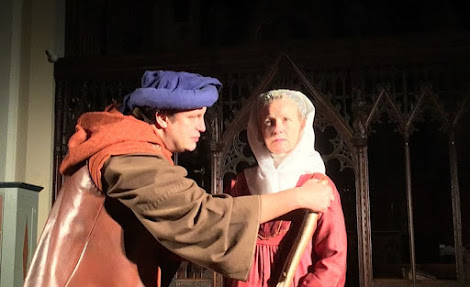
IT IS a pleasure to report that the Mystery play is alive and well — and not only in Ambridge. The Players of St Peter, who began life 75 years ago at St Peter’s, Cornhill, in the City of London, have had various locations over the years, but are now based at St Saviour’s, Chalk Farm, in north-west London, where they presented four performances of this year’s offering, a “director’s cut” featuring four of the 48 plays in the York Cycle, which, complete, depicts biblical events from creation to the last judgement.

These plays — originally sponsored by craft guilds whose names live on in the titles — were The Spicers’ Play (The Annunciation and Visitation), The Pewterers’ and Founders’ Play (Joseph’s Trouble about Mary), The Tile Thatchers’ Play (The Nativity), and The Masons’ and Goldsmiths’ Play (The Magi).

The group’s long tradition clearly shows in the ease with which roles were dispatched: serene Mary, benign Gabriel, Joseph not easily convinced that his wife’s baby had come from God (“Nay, some man in angel’s likeness with some game has her beguiled”), the Magi, one of whom was a woman; and minor characters, no doubt thanks to Gill Taylor’s expert direction, fully engaged with the action — the expressive ox and ass, the kings’ servant shaking his arm back to life after carrying the heavy box of gifts; the star held high on a pole, all this often reminiscent of Shakespeare’s rustics in A Midsummer Night’s Dream.

The music — with solo soprano, recorders, violin, cittern and percussion — was immaculately played by The Mystery Band, with the singer Helen Garrison, and at a small pipe organ was Paul Nicholson, former associate director of the London Handel and Tilford Bach Festivals, whom St Saviour’s is so fortunate now to have as its Vicar. But the actors sang, too (rather well), in impressive costumes, and we all stood to join in The Sussex Carol at the end.

It seems to me that Mystery plays — in the 15th and 16th centuries the most popular and enduring form of public entertainment in Britain, before theatres as we now know them came to be built — could at Christmas come to rival the traditional pantomime for good family entertainment, accentuating the true meaning of Christmas in a now largely secular (and, in the case of the pantomime, celebrity-obsessed) world. Perhaps The Archers, doing this very thing, will draw wider attention to this wonderful, often funny, frequently moving genre, and to groups such as The Players of St Peter, who do it so splendidly.

theplayersofstpeter.org.uk


24 December 2021


Message to Nadine Dorries

The Campaign for the Arts has sent the following messages to the Culture Secretary, Nadine Dorries:

https://www.campaignforthearts.org/dear-nadine/?utm_source=sendinblue&utm_campaign=Good%20news&utm_medium=email

15 December 2021

Stephen Hough

In The Observer, 21 November 2021

‘It was a reminder of how important a cog music is in life. Don’t take it for granted. Tell our political leaders it’s not just entertainment. Not just icing on the cake. It’s the cake itself. It’s human life.’


From The Conversation, 15 December 2021:

Conservative MP rebellion: ‘human rights’ opposition to new COVID measures doesn’t add up

Alan Greene

Reader in Constitutional Law and Human Rights, University of Birmingham

The UK government’s introduction of new restrictions to deal with the ‘omicron emergency’ has prompted backlash from some politicians. When the changes were put to the House of Commons, 99 Tory MPs voted against the plans. Several expressed concern over the impact measures such as having to show proof of vaccination to enter certain venues would have on people’s ‘civil liberties’. They have essentially been invoking human rights arguments to oppose pandemic emergency powers. However, their opposition is based on a misguided and libertarian understanding of the nature of human rights.

Such libertarian opposition to the new restrictions can be seen from some MPs’ recent commentary. Conservative MP Steve Baker, who is in the Covid Recovery Group and a vocal backbencher, accused Prime Minister Boris Johnson of creating a ‘miserable dystopia’ by bringing back rules on face masks and testing and introducing vaccine passes.

Libertarians essentially argue that human rights prevent the state from acting or interfering with your freedom. Any interference to which you do not consent is an act of aggression and is therefore illegitimate. In my book Emergency Powers in a Time of Pandemic, I argue that libertarian understandings of rights as only restricting the power of the state are inappropriate for dealing with a pandemic.

On the face of it, human rights such as those in the European Convention on Human Rights and incorporated into British law by the Human Rights Act 1998 appear to require non-intervention by the state. Everyone has the right to life, everybody has the right to liberty, everybody has the right to privacy, everybody has the right to freedom of expression. Essentially, the state should just leave people alone.

A pandemic, however, actually requires states to be more active, taking positive steps to protect human rights.

For example, the right to life enshrined in Article 2 of the European Convention on Human Rights does not simply require states to refrain from taking people’s lives, it also requires states to protect people from ‘real and immediate risks’. Likewise, the state must spend resources and implement measures to ensure that conditions in state-run institutions (like hospitals and prisons) do not deteriorate to the level that they infringe on people’s rights to humane treatment.

If MPs truly want to protect people’s rights, they should be in favour of a robust pandemic response. A person cannot exercise their other rights if their right to life is not protected. A human rights law limiting the state’s ability to protect people from a deadly threat would not be of much value. Rather than conceiving of human rights law as simply stipulating non-intervention by a state, the key to the success of the human rights movement is its ability empower or ‘emancipate’ people. This places strong obligations on states to protect and vindicate people’s rights.

Whose rights matter?

At the time of the vote, over 800 people had died within the past seven days from COVID-19. While these numbers appear relatively low when compared with the height of the pandemic, they are significantly higher than the deaths caused by other threats that have prompted the British state to enact draconian powers. From April 2003 to March 2020, for example, 95 people were killed in terrorist-related incidents in England and Wales.

It is striking that, while they are opposing new COVID-19 restrictions on a civil liberties basis, MPs are reluctant to voice concerns over other legislation that clearly infringes on human rights. On the very same day as the vote, the government proposed striking changes to the 1998 Human Rights Act, including restricting the right to family life to make it easier to deport people.

Conservative MPs also recently voted through legislation allowing the home secretary to strip people of their British citizenship without notice, and substantially curtailing the right of people to protest — a fundamental right in any democracy.

At best, this is inconsistency. At worst, it is rank hypocrisy.

The reason for this can be boiled down to an ‘us v. them’ mindset. Ultimately, it is the idea that most of ‘us’ – ‘ordinary’, law-abiding people – will feel that counterterrorist powers do not affect us, or that we ourselves are not at risk of being deported. Instead, we view these kinds of human rights restrictions as only impacting the rights of the ‘other’ — the terrorist, the undeserving. In contrast, the effects of COVID emergency powers apply to everyone.

While this distinction explains opposition to some rights restrictions but not others, it cannot justify this inconsistency. This idea of those deserving versus those undeserving of civil liberties has no place in human rights. We have rights by virtue of the fact that we are human, not simply because we are good citizens.

https://theconversation.com/

07 October 2021

A Little Light (Relief) Music

(from the St David’s Hall website)

I can’t wait to hear the choral version of Schumann’s ‘Rhenish’ Symphony!


BBC National Orchestra and Chorus of Wales

 Ryan Bancroft 

 conductor

 Paula Murrihy

 mezzo

 David Butt Philip 

 tenor 

 Cody Quattlebaum 

 bass-baritone

 BBC National Chorus of Wales


 RWCMD College Chorus


 Brahms

 Tragische Overture Op.81 (Tragic Overture) 

 Mozart

 Piano Concerto K.467 No.21 C Major (soloist: Jonathan Biss) 

 Schumann

 Symphony No. 3 Op.97 E-flat major (Rhenish)

 Join your very own BBC National Orchestra of Wales, our principal conductor and a stellar cast of soloists for a classical night of Brahms, Mozart and Schumann.

(Explanation: the performance was originally to have been of The Dream of Gerontius, but ‘someone in the office’ clearly doesn’t realize that this replacement programme no longer involves three vocal soloists and a chorus!)

From The Spectator, 9 October 2021:

Ian Pace

How the culture wars are killing Western classical music

People are increasingly made to feel guilt or shame for loving or teaching Bach, Beethoven or Wagner

Striking the wrong note: musicologist Philip Ewell claimed that Beethoven was little more than an ‘above average composer’

Musicology may appear an esoteric profession. But several events in the past few years have pushed musicological debates into the columns of national newspapers, from the American academic who claimed that music theory was a ‘racial ideology’ and should be dismantled, to the Oxford professor who allegedly suggested that studying ‘white European music’ caused ‘students of colour great distress’, to the high-profile resignation of a professor at Royal Holloway, University of London, reportedly in response to academic ‘cancel culture’.

These disputes have not emerged from nowhere. They are the result of longer processes that have forced serious questions about the very place of music, and above all the Western classical tradition, in Anglophone education.

Music theory has existed in Western universities since the Middle Ages, but the term ‘musicology’ dates from the late 19th century. It refers broadly to the academic study of music, which can encompass areas such as music history, theory, analysis, the study of global musics, acoustics, and more. This type of study, practised in universities, is distinct from that traditionally offered by conservatoires, which focus on high-level professional training on an instrument or voice.

Western classical music long held a central place in university music departments, though from the beginning of the discipline musicologists also investigated folk and vernacular traditions and their social and cultural contexts. But three historical developments underpin the current situation. One of these was the growth of British ‘cultural studies’ from the 1970s onwards, and work from this field mostly on popular musics. Often undertaken by those without specialised musical skills, this study concentrated on the social position of music, associated imagery, fashion, etc., while the sounds it made were frequently a secondary or minimum concern.

Another came from the rise in importance of ethnomusicology, a discipline that developed in the 1950s out of vergleichende Musikwissenschaft, the comparative study of global musics, which had added immensely to the knowledge of these in the West. While still undertaking some of this type of research, ethnomusicologists’ emphasis was as much upon the role that music played in societies as about the sounding music. The latter could become neglected, leading one to sardonically quip the term ‘Eth-no-musicology’.

Many Anglophone ethnomusicologists were also frequently hostile to aesthetic value judgments, recoiling from the hierarchical nature of this, despite evidence of musical hierarchies and value judgments existing in most societies and cultures. For this reason, the existence of a Western ‘canon’ of major works came in for particular censure.

I fear for those in education who are made to feel guilt or shame for loving Western classical music

From the 1980s a number of ethnomusicologists turned their disciplinary approaches to practices within Western classical music itself. Their findings were often roundly negative; selective and unverifiable sources (because they were anonymised), or simply broad generalisations, were used to indict the Western concert, conservatoire, or classical music culture in general, often from a ‘post-colonial’ perspective. (In Christopher Small’s studies of concert rituals, for example, concerts were ‘a celebration of the “sacred history” of the Western middle classes’.)

These attitudes were also found in the third major development, the ‘New Musicology’ that emerged in the US in the mid to late 1980s, many of whose protagonists argued that social readings of music, which reveal its ideological content, should be the musicologist’s principal concern. While this approach was much less ‘new’ than its proponents often claimed, the emphasis shifted towards questions of gender, sexuality, race and elitism. Notoriously, the feminist musicologist Susan McClary likened a passage in Beethoven’s Ninth Symphony to the frustrated, murderous rage of a rapist. The New Musicologists also took a harsh view of much avant-garde music, claiming popular music as a more worthy object of study.

The result of all this often led to what I have described as a ‘musicology without ears’: in other words, a further de-emphasis upon listening or studying the sound of music. This was especially the case as a result of a new emphasis on ethnographic methods based on participant observation, and focused on the verbal rather than the aural, which could be undertaken by those with few specifically musical skills.

A shift from aesthetic to moral judgment accompanied this. McClary, for example, censured Charles Rosen for critiquing certain operas on the grounds of ‘old-fashioned hierarchies of tastes’ rather than for ‘something ideologically pernicious, such as anti-Semitism, orientalism, or misogyny’. A work could only be judged bad if it fell foul morally.

All of this has led to a situation in which it is common to read quite stentorian denunciations primarily of Western classical music and its standard repertoire and long-established scholarly methods for investigating it. Thus, in 2016, the one-time pianist turned video-game musicologist William Cheng published his book Just Vibrations: The Purpose of Sounding Good. Cheng wrote dismissively of such concepts as ‘art for art’s sake’, ‘aesthetic autonomy’, or ‘academic freedom’ and even ‘the belief that academics have a right to pursue their work free from political pressures and without fear of termination’. In place of these, which he associates with a ‘paranoid’ approach, Cheng advocates ‘a care-oriented musicology — namely, for a musicology that upholds interpersonal care as a core feature’. Whether musicology is to be judged to have achieved this was presumably to be determined by him or other ideological fellow-travellers.

Cheng’s passive-aggressive arguments — employing the tropes of victimhood to propound a highly censorious agenda — and some of the extensive praise they have received, are among the most disturbing developments in recent musicology. It is not hyperbolic to compare them to those common under Soviet-style communism, in which academic freedom and integrity were sacrificed in favour of ideological conformity.

Many others have called for the ‘decolonisation’ of the musical curriculum, the ‘colonial’ aspect usually serving as a cipher for the whole Western classical tradition, while others have directly associated Western musical notation or theory with ‘white supremacy’. Then, in 2019, the musicologist Philip Ewell, previously noted for his work on Russian music, shifted direction with a series of publications claiming that music theory embodied a ‘white racial frame’, and that Beethoven was little more than an ‘above average composer’. He focused in particular on a range of nationalistic and racist sentiments found in the work of the Austrian-Jewish musician and theorist Heinrich Schenker (1868–1935). These were already well-known and published, but Ewell went further than others in the equations he made between, for example, Schenker’s beliefs in hierarchies between pitches, and in racial hierarchies in society.

This led to a series of responses, some very critical of Ewell’s arguments, in the Journal of Schenkerian Studies, and in turn to an unhappy series of highly publicised denunciations of the journal, its editors and some of the authors, leading to suspensions and legal actions. To defend anything about Schenker’s work became in some people’s eyes little more acceptable a position than to defend the killing of George Floyd.

Most recently, the musicologist J.P.E. Harper-Scott, author of a range of monographs and articles on Elgar, Walton, Britten and others from a radical left-wing perspective, resigned from a chair at Royal Holloway, University of London, and from academia in general, at the age of 43. Harper-Scott published a statement about this on his blog. In this, he claimed that universities had become dogmatic rather than critical places, and that musicologists were ‘frankly insane’ for believing that cutting Beethoven, Wagner and others from the curriculum would ‘somehow materially improve current living conditions for the economically, socially, sexually, religiously, or racially underprivileged’. He also objected to the ways in which the term ‘decolonisation’ was used to shut down debate and shame dissenters.

Harper-Scott’s resignation statement deserves to be read in the context of his wider writing, expressed most strongly in his books The Quilting Points of Musical Modernism and The Event of Music History, which disprove any suggestions that his is a conservative critique. He had produced scathing critiques of aspects of popular music studies, ethnomusicology, ‘sound studies’ and other developments which he described as ‘crypto-capitalist’, for their denial of the value of a music that does not simply reflect an existing capitalist world but has the ability to reflect back on it or point to other worlds or forms of experience. With the decline in the aesthetic, the only value left for music is its exchange value, and he viewed these movements as openly embracing music as commodity. In contrast, he celebrated radical musical traditions that he felt resisted such a thing, and had personally found some self-liberation in first discovering them while growing up in the north-east of England where such culture was commonly marginalised.

While I believe Harper-Scott’s characterisation can be too all-encompassing, I certainly recognise the situation he describes in some contexts. It is exacerbated by a marked decline in the provision of state music education, especially that involving induction in musical notation and theory. Someone like Harper-Scott would today be much less likely to find a route into becoming a classical musician or a musicologist, and this option may soon become limited to the privately educated.

As one from a similar background to Harper-Scott (though privately educated at music school), who came to classical music simply through natural curiosity and accessibility of materials in a provincial local library, and was transfixed by first encounters with Beethoven, Chopin, Wagner, Ravel or Stockhausen, I find this immensely saddening. These composers will continue to be taught, but to an increasingly restricted social demographic, turning claims of ‘elitism’ into self-fulfilling prophecies. Furthermore, I fear for those in education who are made to feel guilt or shame for loving Western classical music, or those who one American educator asked to undertake an especially demeaning ritual in which students had to step forward to check their privilege if they were taught music theory, cared about notated music, or could read more than one clef.

Moreover, if the teaching of specifically musical skills is allowed to decline further, academic music may struggle to survive at all and could at best be relegated to an adjunct of other disciplines — sociology, anthropology, cultural studies — and might then dwindle through lack of a specific raison d’ĂȘtre.

These various controversies are far from simple disputes between ‘conservatives’ and ‘progressives’ but emblematic of a discipline in which some protagonists lack a sense of its purpose and identity, or any real belief that music has value in and of itself.

It is time to reassert the value of the study of music in its own right, as something one loves or finds fascinating, regardless of whether it has achieved mass-market commercial success. Listening to the music of Bach, Mozart or Beethoven alongside some of their now all-but-forgotten contemporaries is the surest way to appreciate just why such canonical figures are so extraordinary. Attempting to understand why this is the case, which inevitably involves a deeper analysis of the music in question, can be immensely enriching for the ears and the mind, sharpening one’s focus and perception. The relationship of this music to its social and ideological contexts is a vital area of study, but this should be the subject of continuous critical inquiry, not dogmatic platitudes.

There is no need to assert any superiority of a Western classical tradition (I certainly would not do so) over others from Africa, the Arab world, China, India, Indonesia and elsewhere to recognise the important role this Western tradition — like other Western high culture — has played in over a millennium of history, and thus how utterly natural it should be to teach it in Western societies, alongside other popular and vernacular traditions. Invoking Dante, Shakespeare, Beethoven, Virginia Woolf or Pierre Boulez primarily in order to indict them for a range of ideological crimes reveals more about those making the indictments than about these artists.

Ian Pace.

Ian Pace is a pianist, musicologist and head of the Department of Music at City, University of London, but is writing here in a personal capacity. He is co-convenor of a forthcoming 2022 conference on ‘Music and the University’, to take place at City.